Internal systems, portals and CRM workflows built around how your team actually works
Business systems tailored to your process - client portals, sales pipelines, staff dashboards and reporting - built in phases with clear scope.
The challenge
Spreadsheets and disconnected tools create errors, duplicated work and limited visibility.
How Xapner approaches it
We map how your team works today, then build practical tools that reduce double-entry, surface the right information, and give managers a clear picture without forcing you into generic software that almost fits.
What is included
- Discovery workshop to document workflows, users and priorities
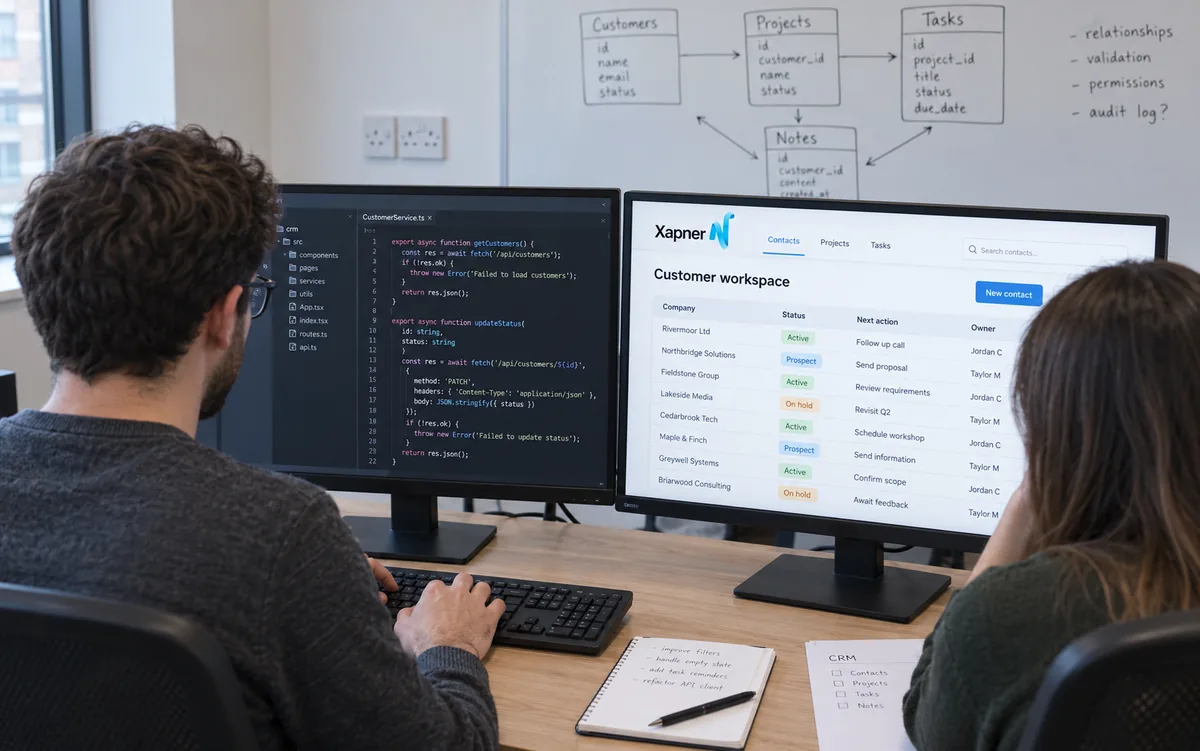
- CRM and sales pipeline systems with stages that match your process
- Staff and client portals for secure access to the right information
- Dashboards and reporting your managers can act on
- Connections to existing tools (email, payments, accounting) where APIs allow
- Role-based access so people see only what they need
- Phased delivery with testing before each launch
- Ongoing maintenance and improvement options after go-live
What is not included
- Hosting, third-party API charges and licence fees for external services
- Unlimited scope changes without change control
- Data entry, migration of unstructured records, or cleaning legacy data unless it is in the written scope
- Fixed pricing before discovery, because features, integrations and users decide the effort
Typical delivery
- Process mapping. We document how work flows today - who does what, where data lives, and what breaks. No build starts without a shared picture.
- Scope and proposal. You receive written phases, timeline, commercial terms and what is explicitly out of scope. Change control is agreed upfront.
- Build in phases. Core workflows ship first so your team can use real features early. Integrations and reporting follow in agreed order.
- Training, launch and support. Staff get practical handover. We support launch and offer maintenance for fixes and iterative improvements.
Typical timeline
Custom projects begin with discovery and a written scope. Delivery is phased and agreed in the proposal; a first usable phase is normally weeks rather than days, and each phase has its own review point.
Ownership and handover
Ownership of the delivered application code and data is set out in the written proposal before the build starts, together with handover, documentation and any ongoing maintenance arrangement.
Questions about this service
How do custom projects start?
With discovery: we map your process, define scope, then propose phases, timeline and commercial terms before build begins.
Related guides
- Build vs Buy Software: A Decision Framework — A scorecard for comparing subscription software, configuration and custom development using workflow fit, risk, ownership and total operating cost.
- API Integration Checklist for Business Owners — A non-technical control checklist for commissioning an API integration, covering ownership, permissions, failure handling, testing and support.
- Connecting Your Website to a CRM: A Reliable Implementation Guide — How to connect website enquiries to a CRM with clear field ownership, consent records, deduplication, retries and operational follow-up.
Next step
Compare the published GBP starting points on the pricing page, see related builds on the work page, or start a brief describing your goal, deadline and any systems that must connect. Xapner replies with a practical next step rather than an automatic quotation.